

•
A Msukuma Body at Rest
• A Msukuma Body at Rest
A Msukuma Body at Rest
A story by CHARLOTTE MAKALA
I did not plan to cry at the salon. “Nime fiwa” I lied, allowing my braider to believe I was grieving the loss of a dearly departed. The truth was, I was not sure why or how I was crying.
All I knew was that one minute, my braider, Da’ Julie, was pulling on my strands with an afro pick, biting her lower lip in concentration and as she braided a pattern onto my scalp, she asked me if I wanted a pedicure. “Why not?” I thought in a state of whimsy, I nodded, and the next thing I knew, a man with a stool approached with a basin of warm water. He removed my feet from my sandals, one after the other, and gently placed my feet in the basin. Next, he carefully folded the hems of my trousers so that they reached behind my knee, nearly exposing my lower thigh and then, and then I began to weep.
The crying surprised me, it happened without warning or permission, without the slow internal negotiations I usually conduct before allowing myself to feel anything at all. I was sitting upright in a plastic chair, my knees angled carefully to avoid touching the woman on my left. I ensured my bag looped around my elbow the way women do when they do not fully trust a space. Then, after letting my feet soak and the pedicurist briefly massage my feet, my eyes were wet, my throat tight, my chest rising in shallow, uneven increments.
The salon did not pause for my feelings. Gospel music hummed from a small speaker balanced on a shelf crowded with jars of hair food and curling cream topped with dust. Someone laughed too loudly at something I could not hear. A woman argued on her phone about money. The air smelled of coconut oil, acetone and the faint burn of heated hair. Outside, the afternoon heat pressed against the glass, heavy and unmoving. Vendors drifted in without asking, holding up phone covers, roasted korosho wrapped in old newspaper, bangles that clink softly as they walked. Da’ Julie glanced at my wet cheeks, believed my lie and murmured “Pole” under her breath, offering her condolences, then parted another section of my hair with her comb and kept working. In Dar, life is about ‘kutengeneza pesa’- making money, because, as affordable as life can be, pockets still feel empty.
The salon was loud in the way places full of women often are. A woman nearby laughed too loudly at something someone had said three chairs away. The smell of acetone cut through the heavier sweetness of coconut oil and hair food warmed by the afternoon heat. “Dada, nyusi?” the eyebrow lady offered to tend to my eyebrows. I shook my head, and she disappeared as quickly as she had appeared.
The heat hovered without mercy. Palm trees lined the street, decorative more than helpful, their thin shadows doing absolutely nothing to interrupt the heat pouring onto the streets of Mwenge. It was early afternoon, the hour when everyone seemed to need something all at once: braids tightened, phones buzzed, children were shushed, chairs scraped against the floor.
I had not even planned to stay long. I came for my hair because I have an interview in a week. Somehow, coming from years lived in Dubai, I forgot that here men are the ones who do your nails and your feet. Perhaps I forgot because it was a woman who asked, it sounded like self-care, something small and deserved.
When the pedicurist approached, I was shocked by how timid I suddenly became, not flirtatious or anything, just shy, the way girls are bashful before they have learned to perform confidence. He was dark, casually dressed and seemingly unhurried. His hands were large, gentle and warm when they touched my ankle to guide my foot into the basin. It was that gentleness that undid me.
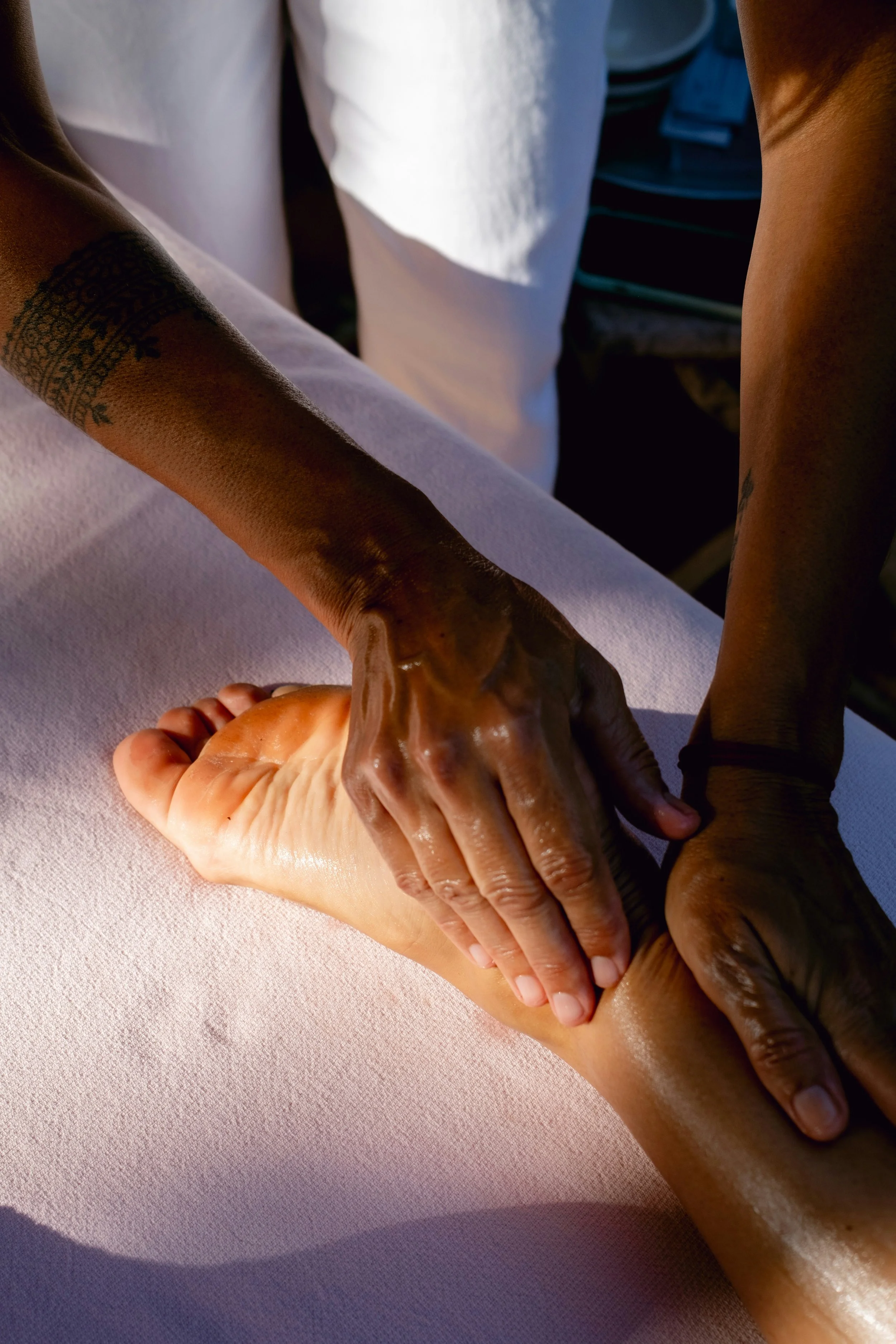
I wiped my tears quickly after receiving Da’ Julie’s condolences. I did not want the pedicurist to look at my face, he didn’t. I did not want to meet his eyes and be seen like that⸺ vulnerable and unguarded in a way that felt almost irresponsible. My hands rested stiffly in my lap, fingers pressed together as I braced for something that never came. When he began to scrub my foot, slow and deliberate, the sensation was overwhelming. The water lapped gently against my skin. Dead skin lifted and floated away in pale curls before disappearing to the bottom of the basin. The pressure of his thumbs pressed into the arch of my foot with quiet confidence, and my breath hardened in my throat. My body reacted before my thoughts could organise themselves, and something in me that had been clenched loosened.
Memories of Dubai simmer to the surface involuntarily. The long days standing on polished hotel floors that never seemed to stay clean enough. The dull ache in my calves by evening. The way my back used to throb after double shifts. Online classes taken late at night, my eyes burning as I tried to stretch a one-year diploma into something that might have changed my life. Feeling homesick for Tanzania, missing my family. And I remember the man I loved, the only person I spoke Swahili with in a place where my tongue always felt slightly foreign. I remember cooking together, sharing spices from home, the quiet comfort of familiarity in a city that never felt like mine. But I also remember the moment I found the messages on his phone, the single bobby pin in his bathroom and the scent of women’s perfume on his sleeve.
Sitting there, my foot cradled in the hands of a stranger who knew nothing about me, I felt as if my body was unlearning survival and teaching itself that not every touch from a man required me to brace myself. In Dubai, salons were women-only spaces, sealed and segregated, tightly controlled by rules and partitions, whereas here the door stayed open and vendors drifted in and out. Men were not included in the rituals of women’s beauty, but neither were they kept away; they passed by, witnessing what, in other places, would have been concealed.
I went to Dubai because staying in Tanzania felt hopeless. At the time, I was doing everything right but felt like life was at a standstill. I had passed secondary school with a division 2, ambition, and a long list of responsibilities that did not seem to care about my plans. My father’s business needed support. My younger sibling needed school fees. My mother carried her own quiet worries, and money never lasted long in my hands. So when a family friend mentioned an opportunity abroad, a hotel job that promised steady pay and the chance to travel, something in me lifted. I imagined myself boarding a plane, passport in hand, becoming one of the few people from my community to leave the country for work. It felt like proof that I was becoming someone. I told myself I was being brave, independent and responsible. I was doing this for my family and myself, because I wanted to see what existed beyond the borders of the life I already knew.
Dubai received me with efficiency, tall buildings that boasted of being able to touch clouds and the first twinkling ray of stars, clean corridors that smelled faintly of disinfectant and expensive oud perfume, and rules posted everywhere as reminders of how order was maintained. I had never seen this kind of wealth so closely before. My Filipino co-worker, Melina, would tease me about it, laughing as she said it was Arab oil money and that I had “better get used to it, habibti.” We called each other habibiti, turning the word into a private joke and a small token of belonging that grew between us as she introduced me to Tagalog phrases and Filipino food.
When I first arrived at the female-only quarters, my passport was taken from me and placed in the care of my direct manager, a gesture explained as procedure but felt deeply personal in its finality. My uniforms were folded neatly and placed on my bed, the fabric was crisp and stiff against my skin, and I was instructed to wear the uniform at all times whenever I was on duty, which meant I lived in it almost six days a week. At first, the material felt restrictive, but over time, I stopped noticing the resistance, or perhaps the fabric softened.
By day, I cleaned hotel rooms that belonged to people I never met. Their beds were rumpled in careless ways. Their towels were damp with the traces of their bodies and lives. Their perfume lingered long after they had gone. I learned how to move quietly and clean thoroughly. At night, I logged into my online classes from my phone, sitting on the edge of my bed, forcing my tired eyes to stay open. I told myself the exhaustion was temporary and that this sacrifice would turn into something meaningful. That I would return to Tanzania as a somebody. That pushing through was what I had always done. After all, I was a Msukuma woman- a tribal identity which means to push. I was a pusher. A woman who kept going and pushing even when my body desperately wanted to rebel and seek comforts like scrolling on TikTok.
Survival left little room for softness, and I became aware of how alone I was in my resilience. I longed for something other than endurance, so when I met Moses, a fellow Tanzanian, it felt like a giant wave of relief to encounter someone who understood me without too much effort. I didn’t have to translate myself for him. We spoke Kiswahili together, laughed at the same jokes, missed the same food, and complained about the same small frustrations that only make sense when you are far from home. At first, there was comfort more than attraction, a sense that we were holding on to something familiar in a place that felt foreign. We cooked together in cramped kitchens that smelled faintly of oil and spices, shared stories about our families, exchanged seasonings brought from home as though they were small offerings of memory. Being with him made the city feel less lonely, and I allowed myself to believe that I had found something worth growing.
Our relationship settled into a quiet routine that felt both intimate and practical, shaped by long shifts, shared exhaustion, and the unspoken understanding that we were each other’s refuge in this concrete desert city. After work, I would sneak to the men’s quarters one floor below mine, since our spaces were segregated and men were not allowed to fraternise with the women and vice versa, but we did it anyway. He would sit at the edge of the bed and rub my feet while scrolling through his phone, half listening as I spoke about exam deadlines and the pressure I felt to succeed, to justify my absence from home with something tangible. I did not ask for much from him because I had learned to keep my needs small to preserve what I thought was peace.
One evening, while he was in the shower, his phone lit up beside me on the bed, and a message preview glowed on the screen. I did not mean to look, but I did, and what I saw was short, clear, and impossible to misunderstand. Plans were being made. Affection was being exchanged in the form of GIFs, emojis, and poorly written English. Promises were being offered to someone who was not me. It was Melina, my only other friend in Dubai. I knew Moses and Melina were fond of each other, but I had thought them to be friendly and polite. I walked out of his room that evening and blocked him on my phone. When I finally summoned the courage to ask him about it two weeks later, he did not deny it. He admitted it casually, as though the weight of the betrayal belonged to me alone. He said he was sorry. He said it did not mean anything. He said many things that sounded rehearsed, and I listened as something else inside me had already determined that it was the end.
I did not cry when we ended. I simply sat in the bathroom, staring at my reflection, feeling a strange numbness settle over me, as though my body had decided to protect itself by shutting down completely. I understood, in a quiet and almost detached way, the appeal of Melina, the ease with which an African man might be drawn to a woman who looked foreign in a different way, whose features carried a tenderness that felt closer to what that world seemed to reward.
I withdrew without ceremony, folding my feelings into the same place where I kept my responsibilities, discipline and my survival instincts. I focused on work, on my studies, on sending money home, on completing what I had started, because productivity felt easier than vulnerability. That same night, sitting alone on the edge of my bed with the city humming outside my window, I made a quiet promise to myself that I would not let another man touch me again, not because I hated men, but because it felt practical and safe. Yet seated in the salon with my foot resting in the careful hands of a stranger, I realised that I was breaking that promise through the simple act of allowing myself to be cared for.
In Dubai, I stopped feeling like a person and started feeling like a task. I slept when my body demanded it and woke up before it could ask for more. I stopped moisturising my skin, stopped paying attention to how I looked unless it was necessary for work. My body became something to manage, not to enjoy; touch felt unnecessary and inefficient. I learned to treat it like a tool, useful for work and little else, something to be maintained. Yet even as I withdrew from it, the world around me seemed to notice it more.
In fact, my body had always been noticed, Dubai taught me how visible an African woman’s body was. My skin was always the darkest in the room, my features always the most discussed. People commented on my butt, my thighs, my lips, my hair, sometimes with admiration, sometimes with curiosity, but often with a hunger that made my shoulders tense. Since puberty, my hips have known to sway with a life of their own, and my backside has always seemed to wave and jiggle, announcing my exit. My waist has always been selfish, drawing itself inward, even when I tried to become mechanical and contained, my body rebelled. I could not help it. My body carried history, geography, and assumptions all at once.
Even my uniform was lengthened to cover my derriere by a supervisor two days after I began working. The supervisor constantly reminded me about modesty and professionalism, whenever I bent too abruptly or moved in a way she felt immodest. I always nodded and thanked her, pretending not to notice the way her eyes lingered. My body was never just mine there. It was observed, assessed, and managed. I learned to carry myself carefully and to move with restraint.
But still, there were moments when male guests brushed past me too closely, their hands lingering under the pretence of accident. I learned to step aside quickly and shrink, because there was nowhere to complain and no language for the unease that I felt. My ex, once a source of comfort, had become a ghost. So I carried the weight of it all alone, navigating each shift with quiet vigilance, aware that safety was something I had to manufacture for myself.
By the time my contract ended, I had money in my account, a diploma added onto my CV, and a heart that felt tired in a way sleep alone could not fix. I boarded the plane home with the kind of quiet relief that comes after endurance. Dar greeted me with heat, noise, and familiarity. The breeze carried the smell of salt, sweat and exhaust fumes. People spoke loudly, life moved loosely, and nothing felt contained. I was ready to start again and build something new with what I had earned.
Now, sitting in this salon, my feet soaked in warm water while the pedicurist handled them, I felt the distance I built in Dubai and the habit of endurance loosen. My breathing deepened, and my shoulders dropped slightly. I was still scared of what gentleness might invite, but I was also tired of carrying myself like a burden. The water in the basin rippled gently around my ankles, and for the first time in a long while, my body felt like a place I was allowed to return to.
That’s what the tears were about, and perhaps in some way, I had not lied to Da’ Julie, perhaps someone had died. The old me passed away. The pedicurist painted my toenails, his movements precise and steady, as though my body deserved time. I realised that I was not crying because of him or even because of Dubai, but because my body finally felt safe enough to respond.
I thought of the little girl I saw earlier, her small fists clenched as the braider pulled too hard on her hair. I thought of how early we learn to ‘vumilia’- to endure and how quickly African women’s bodies understand that discomfort is something to sit through rather than question. I was that girl once, taught to stay still, be useful and taught that beauty required sacrifice.
My toenails freshly painted, and my feet, cradled in a warm, dry towel, were gently patted dry. The pedicurist warmed the lotion in his palms and began to lather my skin. My hairstyle was three-quarters of the way done, when I began to feel - I mean, really take in and register. For the first time in a long while, I vowed that I was no longer going to push through things that required me to be still.
When the eyebrow lady leaned towards me again, her voice light and hopeful, asking if I wanted my brows done, I found myself smiling without effort. “Sio leo,” I said gently, meeting her eyes this time. She shrugged and moved on to her next customer.
When the pedicurist finished, my skin felt smoother, lighter, cleaner, and, most importantly, it felt like mine again. I felt a quiet gratitude for a form of masculinity that did not make my body feel like a product of negotiation.
Around me, the salon continued its choreography. A woman argued animatedly with her sister on the phone about misplaced ingredients. The braiders gossiped and laughed between tight plaits. The little girl from earlier was replaced by another. The gospel song on the speaker about miracles shifted to one about waiting, about seasons changing in their own time. Nothing about the room had changed, and yet I felt different inside it. Grateful.
When my hair was finally finished, I paid Da’ Julie for both my hair and the pedicure. The oppressive warmth of midday instinctively made way for a less heavy atmosphere, though the noise remained just as sharp. I stepped outside and let my bare feet touch the dusty pavement for a moment before slipping them into my shoes.
I thought about the interview coming up in a week and the future I was going to build. My instinct was to move on quickly from that moment, to file it away as a pleasant pause before returning to productivity, but I resisted that urge and stayed with the sensation of being present, in Mwenge, in my body.
May 25, 2026
ABOUT THE AUTHOR
CHARLOTTE MAKALA is a Tanzanian storyteller who identifies as a third culture citizen. Her work explores identity, resilience, womanhood, and the quiet emotional lives shaped by migration, faith, and cultural memory. She writes for a column in The Citizen Newspaper and has contributed to a range of creative projects, including screenwriting, children’s animation, and radio storytelling. Charlotte is also a screenwriter for Ubongo, where she develops educational content for young audiences across East Africa. Charlotte is also the author of “The Color of Promise”, a book of poetry and short stories, self-published on Amazon. Charlotte is currently developing both literary and screen projects that centre African stories with global resonance.
*Cover Image by Filipp Romanovski on Unsplash