

•
Mpanda Mpe Katoni
• Mpanda Mpe Katoni
Mpanda Mpe Katoni
A story by FRANK NJUGI
i
When the white man first came to Kikuyu land
He looked and he said, this is God’s own country
He was mighty well pleased with this land that he had found
And he said I will make here my own piece of ground
Now many's the battle he still had to fight
Many's the family that freed in the night
For many were the Kikuyu men that lived all around
And all of them wanting their own piece of ground~
ii
They say you typically cannot hear a surf sound in a river. The sound of crashing waves is primarily associated with ocean surf, where large waves break on the shore. Most rivers lack the necessary wave dynamics to create that distinct crashing sound. But in Mpanda, the world moves in a dance of its own. On this day, before the rain even came, the tops of the palms had begun to bend. They had leaned in as if listening to something. Then the rain struck. First in wide, deliberate drops, then all at once, ringing down in heavy splashes on the roof and the hard-packed earth. The sound rose and folded back on itself, rain into the river, until Adla could only hear the rainwater mingling with a breaking surf.
The tiny room was dark. The mud house still held the warmth of old fires, as smoke had blackened its walls. A radio placed on a wooden crate near one of the walls, with an antenna bent slightly, played quiet dance music turned low the way it is when no one is really listening, until Kamau came home carrying the meeting in his body.
He found Adla sitting on the earthen floor near an open hearth in the middle of the room, her back curved slightly, sorting maize with the careful patience of someone who believed in tomorrow. Each kernel struck the tin and settled, the sound steady, almost kind. A cooking pot rested on three stones. Ash lay cold beneath it. A few steps from the hearth stood the bed, close enough to feel the ghost of heat when fires were still generous. The mattress sagged in the middle. Everything they owned lived in this one room.
Kamau entered, dripping slightly from the rain outside and stood just inside the doorway. He looked gaunt and sad. Wretched even, in the way men look when decisions have been made elsewhere and must now be transported home. Yet that face, with all its visible damage, was the least defining thing about him at this moment. The most defining thing was the way he looked at her, committing her to memory in case remembering is soon to become his only remaining form of possession.
He did not sit at once. Instead, he began to speak, regaining his childlike capacity to record the world almost photographically.
“They moved the chairs,” he said instead.
“Who?”
“The Mayor’s people. So he would face the window.”
Kamau tried to laugh, but it fell apart midway.
“He stood like this,” he said, trying to joke, squaring his shoulders, lowering his voice. ‘Abakikuyu bashoke kaya.’ He softened it, hoping to soothe her, hoping the words might behave better this time around.
Adla said nothing.
“They kept saying this was always meant to be,” he added. “You know how they say it.”
She wiped her upper lip with the back of her hand.
“And then?”
Kamau looked at her the way one memorises a room before leaving it.
“And then,” he said, very quietly, “there was nothing left to discuss.”
Adla sighed heavily. The waiting was over. Sweat gathered on her upper lip. What she most dreaded had come to pass. And yet, relief had arrived, the uncertainty was over, although thin and sharp as grief.
Kamau and all the other Kikuyu settlers were to leave Mpanda.
He watched her face slowly go dead. There were no tears. But all the selves she had been keeping ready for him collapsed inward at once. For a moment, she was inaccessible and utterly still.
Kamau moved then, the space by the door already beginning to forget him. He knelt and lowered himself beside her. His cool, skeletal hand reached for her knee. He did not squeeze. He only rested it there, as though confirming she was still part of the room. The rain drummed harder. The palms bowed lower. The radio, embarrassed by its own cheerfulness, kept playing.
He pulled her toward him and she let herself be gathered. The two found their way and sank into the bed, Adla settling onto his lap. A pointy peak formed between his legs as she sat on him. He touched her face gently with the back of her hand, caressing again and again. Through the web of her ribs, he felt her heart beating rapidly. The room was cool and starry. Or perhaps warm and starry. From their opulent shackles, they could hear surf rumbling in the distance. ~ Kīrumi kĩa Nganja
*
Before Mpanda became a place one could be made to leave, it was a place people arrived at, from 1961, with their bodies already broken open.
The startling growth of poor Kikuyu runaways came first. Then their shacks. Tin leaned against wood. Wood borrowed from the bush. Bush cut back until the land itself looked startled by its own exposure, as though caught undressing. Where the bush withheld its timber from the dispossessed, others like Kamau reached into the very veins of the earth, moulding a sanctuary from the same humble mud that bore the footprints of the newcomers. Kamau came to Western Tanganyika among the three thousand-plus of 1963, though no one counted themselves that way then. Numbers arrived later, when officials needed proof that something had happened.
Kenya had taught them how land could disappear beneath a person’s feet without actually moving, and explained how land could vanish without going anywhere. In the White Highlands, the Kikuyu had seen their own soil rationed, then fenced, and its ownership renamed. During the years of rebellion, the earth there itself grew suspicious. To stand still was to be noticed, and to stay was to risk becoming an example.
So they crossed.
They entered Western Tanganyika propelled by flight, a primitive baptism might have been underway, of men, women, children passing through dust and border, emerging with nothing but breath and a direction. Mpanda received them without ceremony. The land did not welcome them, but it did not refuse them either. That was enough to begin a life.
At some point, in the succeeding years to 63’, this was classified as a recognised resettlement. And they believed it because belief was easier than turning back. The government called for a ‘Mpanda Scheme’, as by the time Kenya became independent, Mpanda had thickened with lives. Children, who knew no other ground, were born. The shacks grew in personality. The land learned footsteps. Kamau learned the rhythm of the rain here, and its weird surf, but never tried to read too much into it. He learned Adla.
But governments, like the weather, change their minds without consulting the ground.
Tanganyika became Tanzania, and in 1965, meetings began to happen. Quiet ones at first. Words like control and documentation crept into conversations. Borders, once spoken of as only temporary inconveniences, now hardened into ideas. The same Tanganyika men who once spoke of African brotherhood began to ask for permits.
Kamau had sat in the meeting halls for three years, and listened, as if listening keenly might still be enough. He heard the language tighten with each meeting. Him, or them, the Kikuyu Refugees—with authority, their movement and presence were discussed the way one discusses a problem of hygiene.
Outside, Mpanda continued. The shacks held.
And then this last meeting came. The meeting Kamau carried home that day, into the room with the radio, and the rain, and Adla’s listening face. The law was not yet a law. It was still only a shape. But everyone could feel it approaching.
In 1968, Kamau, who had once crossed borders because staying had become impossible, understood with a clarity that made him dizzy, that this place, too, was learning how to ask him to leave, just as Kikuyu Land had. ~ Kĩrumi kĩa Thirikari.
*
Mpanda was a country covered in manigua thicket, and along its river watercourse, flamboyant trees lifted their red tongues to the sky. Wild guinea fowl came and roosted in the evenings. They would call to each other, keeping in touch with each other in the thicket, as they walked and scratched and with little bursts of urgency, and then, as if guided by an older law, they turned back toward the trees that had always received them, toward their roosting trees at the end of their day’s foraging in the thicket.
On the day Kamau saw her for the first time, Adla was beneath a Borassus palm tree, her body arranged carefully inside the shade, the sun touching her fair skin only in small patches and only where it dared. There were sticky buds sprouting from the stalks of tough, sappy plants all over the thicket. There was not much sound around, but the squeaking of small black birds that circled overhead. They sounded like mice, only more plaintive.
Sitting there, she was hidden from all the world and observed only by fish and the daddy-longlegs that skimmed like lightning across the surface of the waters of Mpanda River.
Kamau had entered the thicket looking for a smell, some small mercy of fragrance, or some savour of aromatic shrubs, to remind him that the world could still be kind. It was three months into his arrival in Mpanda. What he found instead was a person, which is always more dangerous.
She looked light and watery like a newt. And the first time Kamau laid eyes on her, her hair looked pale and soft as the grain of fresh-cut wood. He had first looked towards her without uttering anything, taking her angelic sight in, like a delayed evaluation. She conveyed a sense of pensive reflection, and he took her in the way one receives news that will rearrange the future later.
Tall and gaunt, he stood while fog rose from the river, blurring the air until the world softened at its edges. The setting sun lit her up as if it recognised her. She rubbed her damp palms on her dress. How pretty she was, lit up by the rays of the setting sun!
When she finally noticed him, she asked, “Were you looking for someone?”
Not sharply, more as if the question had been waiting for him.
“No,” he said. Then, after a moment, “I was following a smell. The shrubs there,” he gestured vaguely, embarrassed by the poetry of it, “— they keep growing even when the ground seems to have decided against them.”
She smiled. “Mpanda does that,” she said. “It lets things grow that it doesn't plan to keep.”
He watched her say it, the care in her voice, how it moved as though it had learned not to leave fingerprints behind.
“I’m Kamau,” he said.
“Kamau,” she repeated, once, slowly, testing how a Kikuyu name behaved in her mouth. Then, quickly, before the moment could change its mind: “Adla.”
What neither of them said settled between them anyway at that moment: that he, Kamau, was counted differently here, that his alienness followed him like a shadow even in the shade, and that love, if it were to come, would be asked for papers it could not produce. Already, beyond the river and the thicket where they fell, there were rules tightening their throats, and neighbours who would later pretend concern sounded like protection. Kamau felt it then, dimly, the way one feels a storm before the sky agrees. She stayed though. He did not ask her to. And in that choice, something began that Mpanda would soon insist on answering for. ~ Kĩrumi kĩa Wendo.
*
The dry season of 1969 came, and with it those bright days that lie. Light poured over everything. Everything looked sharp and overexposed. Lorries were already waiting to carry the ugly, practical things, belongings which appeared smaller once arranged for departure. Packed among the people were these belongings that had been touched so often they had lost meaning. Pots. Blankets. A radio that wouldn’t survive the road. The insignificant weight of entire lives.
Kamau told Adla about departing.
“I don’t have to leave you here,” he said. “ Come with me.” And he talked fast.
“Lamu. On the Kenyan coast. There’s land! Well, not land exactly, but a scheme. People are being taken there already. It’s good soil, they say.”
Adla said nothing.
“We’d start over,” he went on. “Just like that.”
“Just like that,” she repeated, softly.
He mistook it for agreement. “You’d like it. The air is different. Lighter.”
A future that sounded suspiciously like a second draft of the first one. When Adla pictured him there, with a new Kenyan wife, a woman who knew the ground already, someone appropriate to the land, she felt an ache twist sharply into panic. A giddy rush of acceptance, urgent as nausea. She couldn’t let that happen. The thought hit her with the clarity of a slap.
She burst into tears. And this surprised both of them. Red patches bloomed on her cheeks. Her eyes swelled. Tears streamed down her kittenish face, sudden and uncontained. Kamau looked. His eyes dimmed with a treacherous moisture. He hadn’t expected her to cry.
Later, the lorry would lurch forward. Children would whisper to each other in thin, silver voices. Tall, mostly skinny men with sharp, beardless chins would stare ahead. The heat would be relentless, drenching. Flies would roar softly.
For days, Kamau held her as they travelled, breathing in the sweet perfume that clung to her skin. She closed her eyes and let the sun pour over her face, wondering whether this endurance was all love. ~ Kīrumi kĩa kũthaamĩrio
*
Kamau and Adla keep their eyes fixed on the spectacle before them, because looking away might let it vanish. Arrival, after all that movement, feels like much-needed relief.
At intervals, the bordering vegetation thins, and there are views of pure jungle, whole valleys of it spread between the hills, so lush it almost looks staged. At times, the grass is green and fat, aggressively alive. It is beautiful.
Kamau realises, almost with irritation, what makes this place seem less faded and haphazard than the Mpanda he’d put into for years. This town has been imagined ahead of time. It has angles. Intent. Mpanda had felt assembled out of necessity.
Then, abruptly, the dilapidated houses appear, little colour cartoons, ramshackled and bouncing, as if someone had been careless with a child’s drawings. Surprisingly, rain comes down hard at one point, a sunshower sudden and theatrical, and the lorry jolts as the driver swerves to avoid deep gashes in the road, collisions, the actual jungle pressing in like an overeager audience.
Soon, though Kamau does not yet know it, this chaos will learn a rhythm. In a few years, he will recognise where the worst turns are, when a particular cluster of houses appears, and the exact point where the land drops away into thick jungle on one side. Familiarity will arrive.
This foreign land will try, very hard, to become Kikuyu country.
The lorries grind to a halt. Dust and rain hang in the air together, confused. Kenyan government officials from the Lake Kenyatta Settlement Scheme, as it is called, step forward with clipboards and cartons stacked behind them. Their voices cut through the noise, practised and oddly cheerful.
“Mpe katoni!” they shout in Swahili.
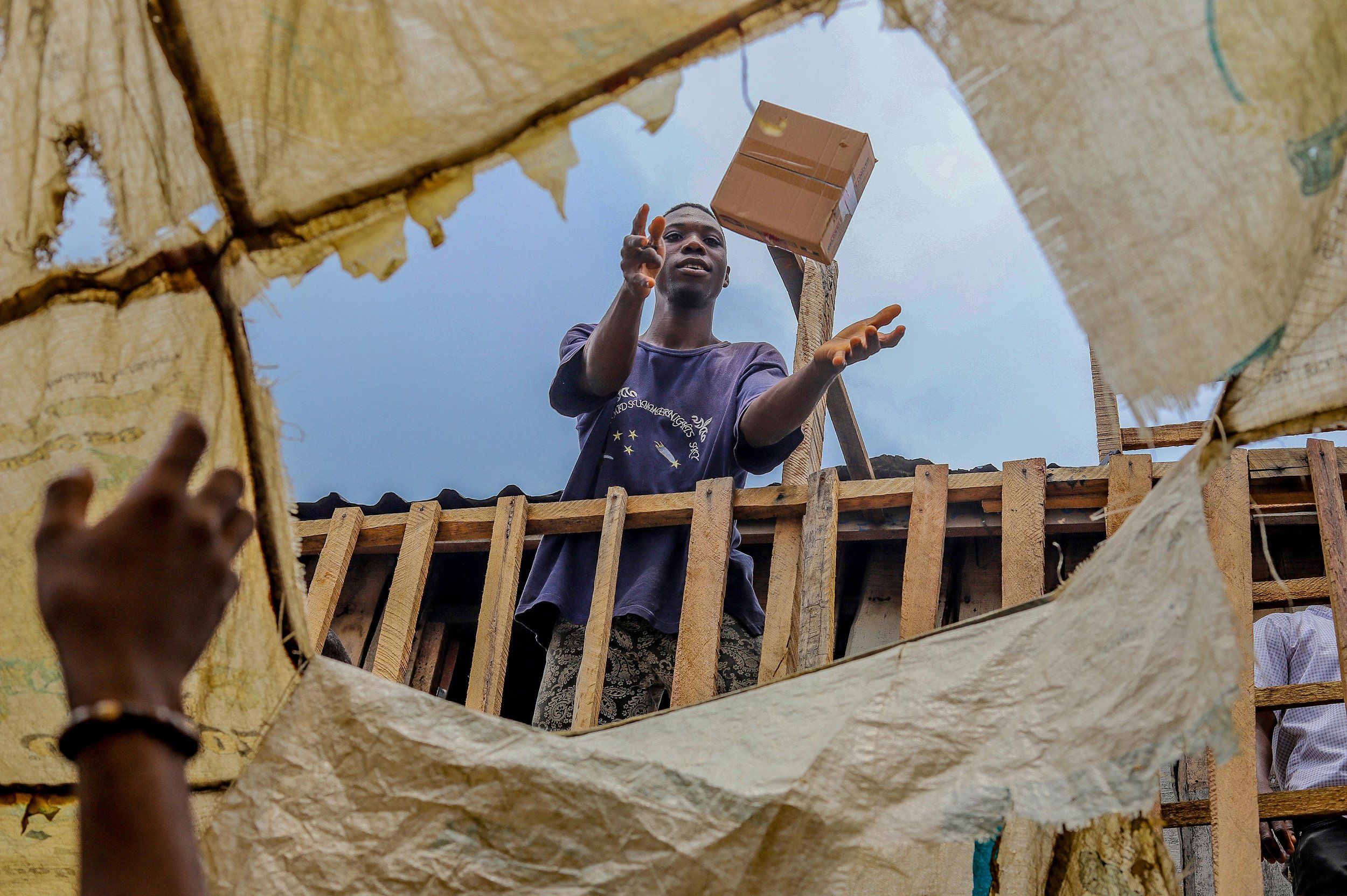
Give him a carton. Give her a carton.
Hands pass boxes down the line. Each family receives one. Katoni. Cardboard smelling of paper and a promise. A new beginning is packaged and being issued.
The words are repeated so often they start to sound like a place instead of an instruction. Mpe katoni. Mpe katoni. And just like that the land acquires a name.
This new place will be called Mpeketoni.
They step down from the lorry clutching their cartons. Kamau holds theirs with both hands, careful, as though it contains something fragile. Adla holds him lightly, almost suspiciously. Nearby, across some distance, a local man with a creased, bare face, like cloth folded too long and finally laid flat, raises his hand to his forehead to block the sun and watches them arrive, expression unreadable.
Adla feels it, her life teetering before her like a view from an unsteady height. Everything feels provisional. The ground, the welcome. The ground feels real. The future does not. But the grass is green. The jungle is vast. The name has already stuck. ~ Kīrumi kĩa kũthaamĩrio gũtuĩka gĩthaka
*
In June 2014, the gun doesn’t shake. That is the unnerving part. It stays there, level, a piece of machinery doing exactly what it was built to do. If time had a face, this was it, as it is dark, counting down without drama.
Adla Amani Kamau knows her name suddenly feels too long for the moment. Named after her late grandmother, Adla Amani Mushi. Beside her, Mbugua Wa Kamau’s hand is rough and hot around Amani’s smaller one. She can't breathe properly. Her breaths come fast and wrong, like she had forgotten the rhythm. Mbugua doesn't tell her to calm down. He just holds on.
The men with the gun talk about land, claiming it. Mpeketoni. Own piece of ground. Unblinking eyes that promise an end to the siblings in exactly one hundred and twenty-three seconds. When the world begins to blur at the edges, the siblings don't feel fear, instead, the minds drift and recall a bloodline of a lineage that has seen this framing before. ~ Kĩrumi kĩa Gikuyu
May 25, 2026
ABOUT THE AUTHOR
FRANK NJUGI is a writer, poet, and journalist from Naivasha, Kenya. His accolades include a nomination for the 2023 Pushcart Prize and recognition as a runner-up in the 2023 ILS– Fence Fellowship. He has also previously been awarded the Sevhage-Agema Founder’s Prize, the Jay Lit Prize for Non-Fiction, and was shortlisted for the 2025 Rajat Neogy Editorial Fellowship. Njugi is an alumnus of the Nairobi Writing Academy, a 2024 African Writers Trust Residency Fellow, a 2024 and 2025 International Literary Seminar Fellow, and a 2026 Macondo Literary Festival TBI residency fellow. He is also the author of a poetry chapbook, Ujana (INKSPIRED, 2024).
*Cover Image by Lagos Food Bank on Pexels