

•
Rain and Feathers
• Rain and Feathers
Rain and Feathers
A story by PEACE UFEDOJO HARUNA
Abuja, 2025
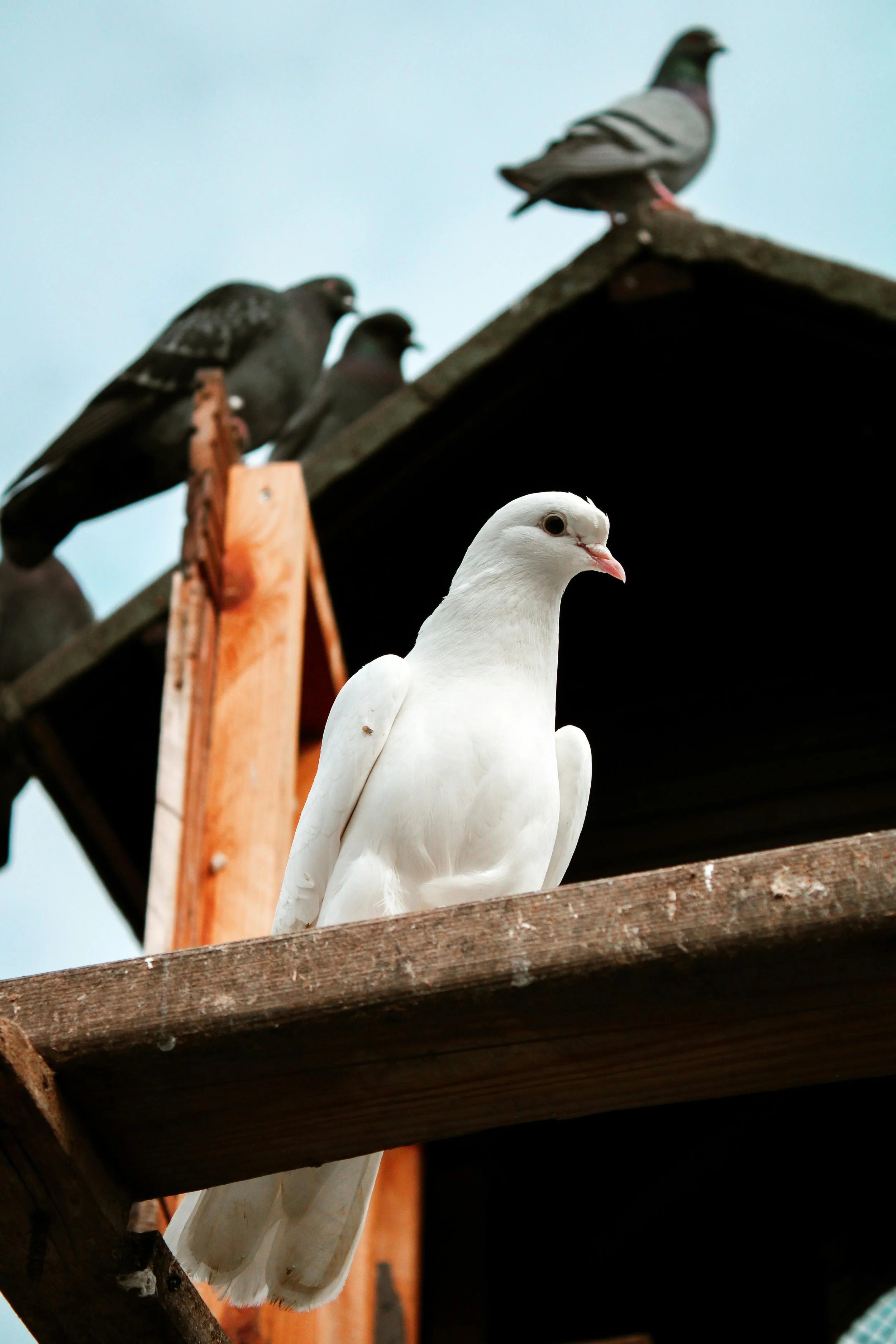
I was a bird the last time I was alive. A white pigeon, to be precise. Whenever humans walked by and saw me sitting on the medicine woman’s roof, they’d call me fat and ask each other what she was feeding me. Some would add that I’d make fine protein in a pot of soup. Yet, no one dared to draw their slingshots against me. That was why I always sat on her roof.
I watched the sun emerge from and drown in the clouds each day. I’d only leave the roof whenever the medicine woman scattered grains on the ground for me to eat. Sometimes, it crossed my mind that she was perhaps fattening me for soup. Then she’d stroke my feathers and gaze at me with a distant light in her eyes. She even began talking to me. And I could only stare back, because I couldn’t speak human language.
She learned how to concoct herbs from her mother’s mother. She knew which herb cured each sickness, sealed sores, and healed wounds. She had a garden beside her hut. People brought their parents, children, brothers, sisters, husbands, or wives to get treated by her. Most times, I’d see a wife pulling her husband’s ear when they leave the hut.
“Did you enjoy looking at her bosom, eh? Tell me! You should have her as your second wife since you love them so much.”
They used this threat because they knew that their husbands would never dare to do it. Not after her husband and daughter died in their sleep. It happened three days after I first perched on her roof. She walked around the village barefoot and sat on the ground, clawing at the red dust and pouring it over her head. Sometimes, I feared that she’d run out of tears and begin to cry blood instead.
At first, she started muttering to herself. She’d draw patterns on the ground with a branch, trace them with her fingers, then burst into laughter. Soon, silence fell upon the house. She’d just walk around with chapped lips from dehydration, reddened eyes, and a rumbling stomach that she refused to feed. Then she finally started talking to me. That was when she began accepting patients again.
One day, the sky darkened. Pale-skinned men with red feathers and shells on their heads stormed into the village. Shooting at every living thing with an iron pipe that spat thunder.
A pigeon may get tossed by the wind, lose its flock, and fall into a hidden village just like I did, but a pigeon never loses its memory. Parents held their children while thunder tore through their chests. The thundering humans set fire to huts, and as the flames crackled, I could hear the screams of some villagers who had hidden in their homes.
The medicine woman’s home wasn’t an exception. It took a while before they got to her hut, and she would have had enough time to run, but she didn’t. Instead, she smiled at her garden one last time, then back at me, before walking inside. I was flying away when the thunder got me too.
“This birdie is as big as a chicken. We’ll have some fine stew tonight.”
I fell with a thud.
When I was a bird, I thought eggs were the only fragile things. Humans didn’t know what it was like to be weak and helpless. They towered over other creatures and could do almost anything except fly. And although they could not fly, they owned every soil they left their footprints on. I used to imagine the kind of terrible things that could happen if humans learned how to fly.
However, in this new life of mine, humans can fly. They didn’t evolve wings, instead, they created enclosed metal canoes with iron wings and blades to fly long distances. These canoes bolt through clouds faster than any bird I know. Humans have built cities that reach the sky. They no longer use horses or camels to move. They now have magical carriages and palanquins that move on their own accord.
Yet, I’ve come to realise that humans are also fragile little things. I should’ve known when the medicine woman cracked after losing her family. Each human is like a cauldron of cacophonies set on a creaking stove. A little shove and it falls to the ground and shatters, spilling everything within it.
Today, I set off on a journey to carry a child.
I keep a picture of my mother, who wears the medicine woman’s face in the pocket of this oversized garment, before leaving my house for a place heavy with promises. In this life, Mother wasn’t a medicine woman. She was a seamstress. Every day, women flocked to our house to make new dresses. At night, I stayed awake, tossing to the rattle of her aged sewing machine as she pedalled. When she was done sewing, she’d place the clothes on the lifeless human-like figures that stood in her workshop.
Four days ago, I returned home to my husband and mother-in-law. They sat together on the three-seater sofa in the sitting room, while I sat on the single one adjacent to them. I knew it wasn’t a pleasant visit. She was clenching her teeth and tapping her foot like an overloaded electric generator.
“You have nine months, Ajanigo! Nine months! If you don’t give us a child by then, we will bring someone else to replace you. This place stinks of silence! Are there two men in this house?”
Idakwo sat there without a word. My stomach tightened.
The past few months have been tense between us. Especially since he asked me on our wedding anniversary dinner, “why haven’t you even gotten pregnant once?”
I scoffed and pushed my plate aside, casting him a cold glare, “do you really want to go there?”
He gave no response and continued eating.
On days like that, I’d stand in the shower, wishing I could call my mother. When I was eight, a woman showed up at our doorstep with an infant boy. I could see Mother’s face heat up. She asked Father to explain himself.
“I don’t need to. She has given me a son and will stay with us henceforth.”
Mother returned to the kitchen without saying a word. She slept in my room that night, and by 4:00 AM the next morning—the time she usually rose to prepare breakfast for Father and me. She stuffed my clothes into a box, went into the room where Father slept soundly with his new woman and took out her things. We left before sunrise, and I didn’t see Father till I was fifteen years old.
I resented her for it. Especially as we moved into an apartment with a leaking roof and doors nearly falling off their hinges. The ceiling had large brown stains from rainwater and rust which had accumulated over the years.
Now, I wish I had her courage. The courage to leave.
“It will rain today,” I say, shoving a foldable umbrella into my handbag.
Idakwo hums in response and continues scrolling on his phone.
I’m supposed to go to a place that’ll rewrite my story. However, I have no directions to that place except for the piece of paper Adaobi had squeezed into my hands when I ran to her house, bawling three days ago.
Idakwo doesn’t bid me goodbye when I leave the house. I flag down a motorbike, which takes me to the park. When I get there, I unravel the piece of paper and begin to ask questions. I take a bus to the town where the address is located, and when we get to the bus stop, the driver describes how I’ll get to the place. I hail another motorcycle and spell out the directions as the driver told me, and after fifteen minutes and a seemingly endless trail of untarred roads, the motorcycle stops at a bungalow.
I pay off the motorcyclist and approach the house. It has no fence, but it has an expensive front door. The knob is carved in the shape of a lion’s head and sprayed gold. The threshold is covered with marble tiles from the floor to the walls. I ring the bell.
“Who dey there?” A voice yells from inside the house.
“Erm. My name na Ajanigo. My friend Adaobi direct me come here.” I respond.
“Oh! Abeg no vex. I dey come.”
Within a few seconds, footsteps approach the door accompanied by the rattling of keys. The door opens with a click, revealing a grey-haired woman curving her lips into a smile.
“Come inside. I’ve been expecting you.”
Lokoja 2012
It’s 3 am, I can hear rain approaching like a rising applause on rusted roofs blocks away. Above me, steady rhythmic raindrops gear up for the momentum of nighttime downpours. Two days ago, my seatmate in class was talking about how much she loved the rainy season. One moment it’s sunny, in another, it’s raining as if the sky was apologising to its lover— earth for the heat. Meanwhile, in my neighbourhood, clamours ascend with the chatter of rain.
In a few minutes, rainwater will begin to seep into the room, and we will start to hear raindrops from the leaking roof clanking on Mother’s pots. Each time it rains, we discover a new leak. Mother will shove her deserted wrappers into my hands, I will fold them and squeeze them into the gap beneath the door to stop water from getting into the house. We will then place buckets beneath the leaking roof and return to sleep.
I’ve been finding it difficult to sleep. My monthly flow always comes with an entourage of excruciating pain, biting my nerves and grinding against my bones. My stomach has become sensitive and the bowl of cold beans I had at 9pm has left me with indigestion. Menstrual pain and an upset stomach weren’t on my checklist for tonight. I’m curled in a fetal position, hoping to sleep off soon. There’s less pain in sleep.
Mother kisses her teeth and rolls off the bed. The thuds of rainfall on our roof must have woken her up. She carries out the nighttime rain ritual. She doesn’t bother me to help her. Instead, she goes into the kitchen, turns on the kerosene stove and heats up aju mbaise—a combination of herbs wrapped in the shape of a doughnut. Mother pours the medicine into a plastic cup and brings it to the bedside.
“Sit up!” She says.
I groan before managing to comply.
“At this point, I don’t think I should be telling you when to take medicine. Don’t leave a drop.”
Mother hands the cup over to me before climbing into bed to sleep. I gulp down the entire medicine, ignoring the pulsing bitterness as its warmth spreads through my body. The last thing I remember is dropping the cup at the foot of the bed.
I open my eyes. The flame from the kerosene lamp hanging on the wall sways.
Everything is floating.
The cup, our shoes, and my books are floating on the surface of the water. Even some of the fabrics that Mother’s customers had given her to sew. My heartbeat quickens as sleep immediately vanishes from my eyes. I’ve never seen rainwater rise this high. I tap Mother to wake her up. It has covered our bedframe and is soaking the mattress.
“What is it?” She sparks from her sleep.
“Water!” I exclaim.
She lets out a loud gasp. Her eyes widen as she jumps from the bed, into the water and rushes towards the door.
“Where are you going?”
“We need to get out of here.” She says, pushing the door.
Is this how we’re going to die? My chest tightens. I suddenly find it hard to breathe.
“What are you doing there? Come and help me open this door!” She yells.
I step into the water, dragging myself towards her as the water pushes against my knees. The door doesn’t open. Mother frantically throws her body against it. I twist the knob first, then proceed to kick it with my heel. It doesn’t budge.
“Stop.” Mother pants. She stares at the water, and her face loses its colour. For a moment, it’s like she’s lost in a vision. “It won’t open unless someone pushes it from outside.” She pauses. “Look. The water is rising fast.”
My heart pounds and tears burn my eyelids. “Mummy—”
“Don’t be scared,” she pulls me into her arms and wraps me in her embrace. “I’m sorry for letting you suffer this fate again. I’ve been selfish.”
Warm tears land on my shoulder. Mother sniffs and wipes her eyes with her wrist.
“I’m sorry, my éwé.”
The world comes to a standstill. Have I heard wrong? It can’t possibly be. Only one person has ever called me that. The medicine woman.
“Y-you remember? All these years I tried to remind you—you actually remembered?” I’ve lived most of my life thinking those memories were hallucinations or nightmares. I thought I was possessed.
Mother sighs and shakes her head. “I’m sorry. When we died, I took your soul and kept it in my favourite shell, so that when I get to live as human again, you’ll be by my side.”
“What do you mean by that? Who are you?” I pull away from her.
“I am an alijenu from Ofu River. When women come to the river to seek children, where do you think they come from?”
What is she even talking about?
“I am a water spirit, Ajanigo. My human mother was unable to have children. It was Mother Spirit who sent me here to become her child. Now, it seems like time for me to return.”
“No! You’re not going to do this again. You’re not just going to give up just like you did last time.”
“Ajanigo…” She trails. “I’m sorry. I will not hold on to you any longer. There’s so much misfortune that comes with being human.” Her voice quivers as she squeezes my hand.”
The water has risen to our torsos.
“Mummy, we need to call for help. Let’s get out of here. We can talk about this later.”
She purses her lips and glances at the window. It’s so tiny. Even though we break the bars shielding it, we wouldn’t be able to pass our heads through it, let alone our full bodies. Mother’s hands ball into fists. Her body is trembling, and her eyes are glossed with tears.
“Ajanigo, I’m scared. I don’t want to go back. I don’t want to leave you.”
“You don’t have to.”
I push my body through the water to the window and begin to scream, “help us! Is anyone there? There are people here, please help us!”
Mother draws me back and places her hands on my shoulders, “listen to me”.
“Mummy?”
“Close your eyes,” she instructs.
I obey, and she covers my ears with her palms. Her warm breath fans my face as the water around us begins to ripple. I wrap my arms around her waist and pull her closer, taking in the smell of kerosene lingering on her clothes till I can feel her no more.
My eyes shoot open. I find myself in front of the place she took me from eight years ago.
Mother is not with me.
Abuja, 2025.
Growing up, my teachers praised me for having a photographic memory. It helped me top my class from primary school to university. I always had perfect grades. Even in my job as a teacher, my impeccable memory has kept me as the best staff. I studied History, but the school makes me teach three subjects; History, Government, and Economics. I don’t mind though, they pay me twice the usual salary.
However, the inability to forget is a flaw. These days, I’ve been trying not to remember. That’s why I moved around with the piece of paper Adaobi had written directions to this place on. The description is in my memory, but I have refused to use it in hopes that using my memory less will cause it to falter.
“Your belle dey your back. Come back next week, and I go massage am again. Make e fit return to its proper position.”
I stare at the carved flower on the ceiling, trying to process the torrents of excruciating pain I just passed through. Tears roll from the corner of my eyes, soaking the pillow under my head. I want to respond to her, but a sob breaks through my lips instead. I can’t come back here. No. I’m not even labouring to bring forth a child, and I’m already going through so much pain.
The woman sights my tears and uses the edge of her wrapper to wipe them. “No cry, my pikin. When you finally become mama. You go forget all this suffering.”
“I don’t think I can become a mother.” I finally say.
“Why you go talk that kind thing?”
I want to tell her everything. That my husband forces himself to sleep with me and each time he does, he can’t bring himself to leave his seed in me. Everything is dry between us except for the sweat rolling off his head while he carries out the mandatory punishment. The look of distaste on his face gives him away each time.
“Nothing. I’m just tired of this,” I reply.
“It’ll soon be over, my pikin. By the time I finish massaging your womb next time, you’ll be pregnant before you know it.”
I force my back off the straw mat and put on my shoes. “I’ll be back next week.”
I’m lying.
One thing living as a human has taught me, is to never be taken unaware. Mother’s experience has made me driven by probabilities. That’s why I’ve been writing external exams for some students and receiving payment from parents that’s far above my one-year salary. I’ve also been writing degree exams for some politicians. I make good money from it and have bought a house with two bedrooms in a quiet estate. So that when my husband and his family decide that they do not need me anymore, I’ll not end up as debris in a flooded house.
I never saw Mother after that flood. She died nameless. Categorised among casualties when the government spoke about it in the news. I still wonder why she could not save us both. Father, on the other hand, didn’t want to take me back in until his wife convinced him to. All the days I spent in that house were filled with her reminding me of her benevolence and how much I owed her. I cleaned the house twice a day, cooked, did all the laundry, and handled her shop while receiving constant beatings. When I got into the university, resumption meant freedom and holidays were dreaded.
I married Idakwoji four months after we met in my father’s wife’s shop. I didn’t feel warmth in my chest the first time I saw him, and his smile never brightened up my day. The graze of his fingers on my skin did not make my belly flutter. I just wanted to leave that house.
Barely a month into the marriage, he started acting strange. He spent most nights at his best friend’s house watching football. Sometimes, he’d return the next morning reeking of alcohol. It took him five months to finally touch me, and it was awful—it still is. I had my suspicions. Maybe he was lying about visiting his friend and was seeing another woman. So, I went through his phone while he slept and I found out my rival wasn’t even a woman.
I bid the old woman goodbye and step out of the house. The ground is wet. I chuckle. It actually rained. A motorbike approaches, and I wave it down to take me to the nearest bus stop. The golden glow of the sunset warms my face as the wind whisks through my hair. The memories of flying in the evening sky with my flock overwhelm me. A sudden weight lifts from my shoulders, leaving me light like the first time I flew.
When I return to that house, I’ll say, “I know you’ve been sleeping with your best friend."
Idakwoji’s fingers will twitch and stiffen. He will finally look me in the eye after many days. “What do you mean by that? How dare you say such a thing?”
“Since you and your family have decided to place an ultimatum on me giving you a child, I’ll leave now. On my own terms. But don’t worry, I won’t tell them the truth.”
He will grab my shoulders, dig his nails into my skin as if daring me to continue speaking, seething, “you’re saying rubbish.”
“You can never stop taking me for a fool, can you? Continue with your act. I’m done with this play.”
I will tell him that I do not want him anymore. I only want my mother. I hope she comes back to me. As a child, a friend, or a bird
May 25, 2026
ABOUT THE AUTHOR
PEACE UFEDOJO HARUNA is a creative writer and social impact advocate with a B.A degree in International Studies and Diplomacy from the University of Benin. Her works have appeared in The Shallow Tales Review, Kalahari Review, Ethel Zine, Brittle Paper, and North Dakota Quarterly, amongst others. She won the Ma Kẹkẹ Flash Fiction Contest (October, 2022). She was a finalist in the 9th Korea-Nigeria Poetry Feast, Wakaso Poetry Prize (July, 2021), and the Parousia Christmas Short Story Prize. She also made the longlist for the Sevhage K & L Prize for Fiction and the Ma Kẹkẹ & Ama Ata Aidoo Award (2025).
*Cover Image by Feslegenli Rotalar on Pexels