

•
Memory of Our Invisible Heroes
• Memory of Our Invisible Heroes
May 25, 2026
Memory of Our Invisible Heroes
An esssay by SAMBA YONGA
My father served as a home guard in Zambia during the 1970s—a civilian auxiliary defence force established to protect key national sites during the liberation wars—at a volatile period when our country was under attack from Southern Rhodesian forces due to our support for the liberation struggle. Infrastructure was a target, and bombings were a real threat. He was stationed at the critical Kafue Gorge Tunnel, where Zambia produces hydro-electric power, and at transmission towers for the national broadcaster in Bauleni, Lusaka and Mwembeshi Satellites—the very lifelines of the nation.
He recounts the story of a night when his fellow guard was incapacitated and unable to go along for the patrol. Despite intelligence reports that an attack was imminent, my father made the decision to patrol alone. He walked the perimeter of that target in the dark, risking his life to protect a national asset.
When I recently called him a “freedom fighter” for this act, he demurred. He did not see himself that way. He understood it simply as his duty.
This reluctance reveals something profound about how we define heroism. What makes a hero a hero? They perform a heroic act, and in witnessing this act, we proclaim them exceptional. Heroes are partly given the status of heroes because of their visibility. We bestow accolades upon them for intellect, wisdom, or courage, using these witnessed moments as the benchmark for human value.
Consider how we commemorate our African freedom fighters, business leaders, presidents, activists, athletic champions and others who hold similar status with unwavering consistency. Acts of validation are constantly performed to immortalise their heroic acts. For example, the Freedom Statue, unveiled 10 years after Zambia’s independence, depicting freedom fighter Zanco Mpundu Mutembo breaking the chains of colonial oppression, stands as a constant reminder of the men who fought for Zambia’s freedom. Zambia’s independence struggle can’t be narrated without mentioning the name of Julia Chikamoneka—the woman who stripped in front of visiting British colonial officials and alongside her band of women to signify their resistance and protest at colonial government. Statues in honour of formidable women leaders, queens and warriors now rightfully take up space across African cities in Benin, in tribute to the Dahomey all-women army, in Angola as a tribute to the powerful Queen Nzinga, in Ghana, where the memorial of Yaa Asantewaa has been built. Similarly, the iconic Nelson Mandela monument in Sandton Square in Johannesburg is a beacon of the legacy of South Africa’s apartheid struggle, whose global narrative is largely understood through the icon’s lens. Business leaders build architectural monuments to the brands they have built, and a search on the Internet will reveal thousands of images of graffiti and other monuments of activists from Steve Biko to Wangari Maathai, who have their name planted in history as a reminder of the good works they have done. We witness sports women and men achieve their supernatural feats and get awarded with trophies. We build statues and present ceremonial prize ornaments for the visible heroes to celebrate them. This has become the framework through which we archive our society and becomes how we keep record. The record, however, is incomplete because there are gaps. The gaps reveal an unspoken silence that tells a larger story about how we define the status of a hero.
Though the accolade being given for the heroic act is justified, visibility as the only metric for value is flawed. By focusing only on the “event” of heroism – independence of a new nation, “ending” a war, solving a global health crisis, unveiling an architectural feat, winning an election – We have created a society that suffers from collective amnesia regarding the “process” of survival and eventual accomplishment. This process is not designed by the act of heroes alone; it is a much more complex formulation. Even though this is widely accepted and well known, it begs the question of whether it is often dismissed. Everyone knows that the architect designs the building that wins the prize, but the architect does not necessarily lay the brick that actually creates the physical edifice. The process of physical building and laying brick by brick is, in itself, an act of required validation, and there is a need for a “process of validity” to position it as an act worthy not to be forgotten.
This amnesia is not accidental; it is structural. We can see the evidence of how we actively erase these “Invisible Heroes”—the sustainers of our society—in three distinct ways.
Consider the paradox of the “Essential Worker.” During the recent global pandemic, the veneer of our celebrity culture cracked. Suddenly, we did not turn to the CEO or the politician or the celebrity as the motivation for us to be “saved”. In a world that is profuse with celebrity influence delivered to us via social media and digital age gadgets, the definition of a “hero” has become even more blurred, with the comments sections inundated with mentions of how their current “100K” influencer is their hero. With the pandemic, we realised that the “essential” people were the health workers who we turned to for healing, suppliers who provided protective equipment for us to move around safely, and providers who could supply essentials like food and household needs. For a brief moment, they were hailed as heroes. But because our system lacks a “ritual of validity” for them, this recognition was fleeting. As sociologists have noted, they became "sacrificial" rather than “validated”—praised in rhetoric but unprotected in structure. As soon as the crisis passed, they were relegated back to the shadows.
In the indigenous Zambian homestead and most African communities, the physical layout of life was communal. Particularly when we are referring to lineage or domestic slavery. This status was very different from the trans-Atlantic slave trade; it was experienced as social dependency and integration. While hierarchies existed—and indeed, forms of servitude or pawnship were present—the “servant” was often integrated into the lineage, eating from the communal pot, and frequently marrying into the family. There was no architectural “backstage” where human beings were hidden away.
However, contact with colonialism and modernity shifted this geometry. We inherited the colonial “Main House” and the “Servants Quarters”(SQ)—structures designed explicitly to segregate the master from the servant. In the recent past, you would find the hired help eating alongside the owners of the home, but more and more in contemporary urban settings, that has changed. I grew up in the 90s, eating alongside our help; we used the same bathroom and ate from the same pot. Today, we have tragically adopted this architecture of separation as a status symbol. We build high walls, require uniform dressing and separate “quarters,” mimicking the very structures that were designed to silence us. We have gentrified the colonial logic of invisibility, viewing the ability to conceal our support staff not as a loss of community, but as a marker of success. We have built a physical world that says: “I want your labour, but I do not want your kinship.”
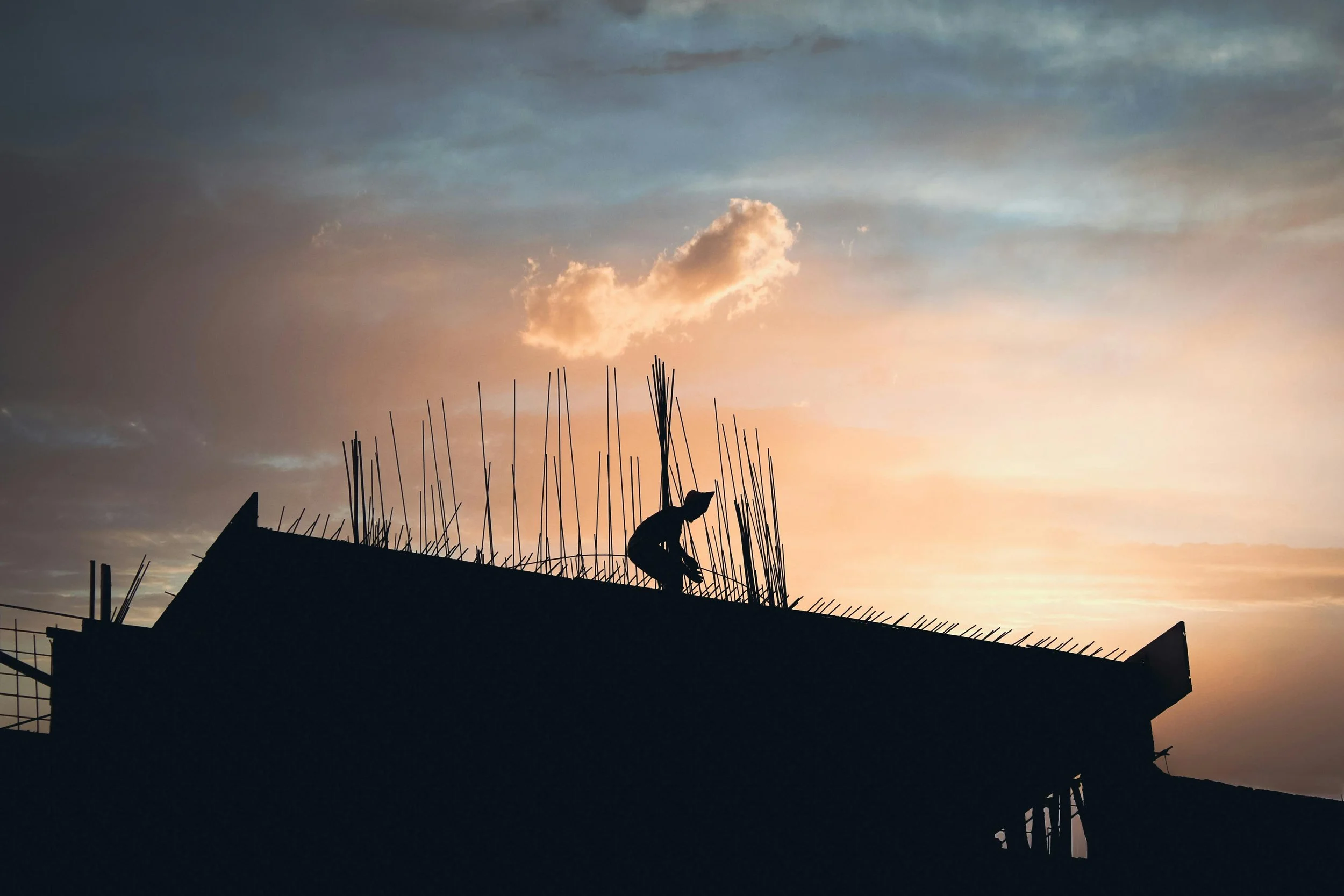
In an urban metropolitan setting, the number of buildings and infrastructure is a testament to the city with stature. Even though it takes large teams of experts and workers at various levels to achieve this, very rarely is this made visible. When a great building is inaugurated, the plaque on the wall bears the name of the Minister, the Financier, and the Architect. It never lists the names of the bricklayers who mixed the mortar or the welders who fused the steel. The physical risk and the tangible creation belong to the invisible; the memory and the glory belong to the visible, not the invisible.
My father’s reluctance to call himself a freedom fighter came from belonging to one of the last generations to go through an indigenous initiation of validation. In most coming of age initiations in indigenous societies, part of the process of going through the “obstacles courses” is to activate the senses in you that build resilience but also create awareness of your surroundings and how to operate in them and lastly identify your abilities and activate the values that ground you as integral part of society and enforcer of continuity in the community. Even though the ritual was diluted by that time, he still carried the residue of a system that told him: You are necessary, your contribution matters, and the initiation was, in a sense, his “monument” of recognition. His sense of worth was not dependent on a medal or public acclaim; it was internal, encoded by a cultural memory that defined him as a protector of the collective and validated by the community. This meant that he did not need to be “seen” to know he was valuable. My father understood that by virtue of being a member of a community that practices a process of validity, meant that his contribution, no matter how small or big, was something of value.
How do we recover this sense of intrinsic value? We must look to indigenous wisdom, which understood that human value is not transactional—it is ontological.
In The Healing Wisdom of Africa, scholar Malidoma Somé argues that indigenous ritual and initiation are not merely a ceremony, but a vital “technology” of community maintenance. He writes that ritual is necessary because it allows us to “remember” our purpose when the distractions of the world make us forget. For Somé, the absence of ritual creates a “sickness” in the community, where individuals feel disconnected and unvalued.
In the Dagara tradition, he describes, and similarly in Zambian indigenous systems, a ritual of validation (initiation) was performed when a young person came of age. This was not a party; it was a rigorous recording of memory. It was the moment the community gathered to tell the individual, “You are here. You are one of us. You have a purpose.”
By acknowledging their transition into adulthood, the community was putting on record that this human being was magnificent and necessary. As Somé suggests, this ritual “fused” the individual to the community. It did not matter if they were destined to be a drummer, a farmer, a midwife, or a chief. The ritual validated their existence before they ever performed a specific job.
This indigenous practice offers a radical alternative to modern “meritocracy.”
Modern meritocracy tells us: You are worth what you produce. It creates a manufactured form of equality that is actually exclusionary, filtering out anyone who doesn’t fit the narrow definition of “success.”
The Indigenous Ritual of Validity, which is a process of validity, tells us: You produce value because you are worth something.
The memory of that validation becomes the anchor of the individual's life. It allows the sweeper to sweep with dignity, not because they are “just a sweeper,” but because they are a validated member of the community, ensuring the health of the collective. It allows the leader to lead with humility, knowing their validity is no greater than that of the bricklayer.
This is true equality. It is an equality based on the memory that every node in the network is essential. The bricklayer and the architect. The female freedom fighter and the male freedom fighter. The trainer and the athlete. The secretary and the C.E.O. The General and the corporal soldier.
If we want to build a sustainable society, we must return to this practice of Epistemic Repair regarding our labour force. We must stop viewing the “invisible heroes” as background scenery for the lives of the “visible heroes.”
We need to recover the memory of the bricklayer, the guard, like my father, and the cleaner. We need to re-institute a sense of validation—a modern ritual of repair—that tells every citizen: Your contribution is the glue holding this nation together.
A society that only remembers its generals and forgets its gardeners will eventually starve. But a society that remembers—and validates—every set of hands that builds it is a society that can truly thrive.
ABOUT THE AUTHOR
SAMBA YONGA is the co-founder of the Women’s History Museum of Zambia, a cultural curator and a strategic communications executive dedicated to the decolonisation of African heritage and the reclamation of indigenous knowledge systems. Her practice explores “epistemic repair” through diverse media, with work featured on BBC Africa and in the publication Museums, Decolonisation, and Restitution. Yonga’s research spans from advocating for the sanctity of African objects to pioneering digital repatriation projects in Zambia’s Gwembe Valley. As a cultural curator, she focuses on empowering source communities and addressing the “incomplete records” of history, bridging traditional wisdom with contemporary archival practices to recognise the vital contributions of "invisible” artefacts, knowledge systems and communities.
*Cover Image by Riiyad on Pexels