

•
The Salt Wife
• The Salt Wife
The Salt Wife
A story by YEAYI KOBINA
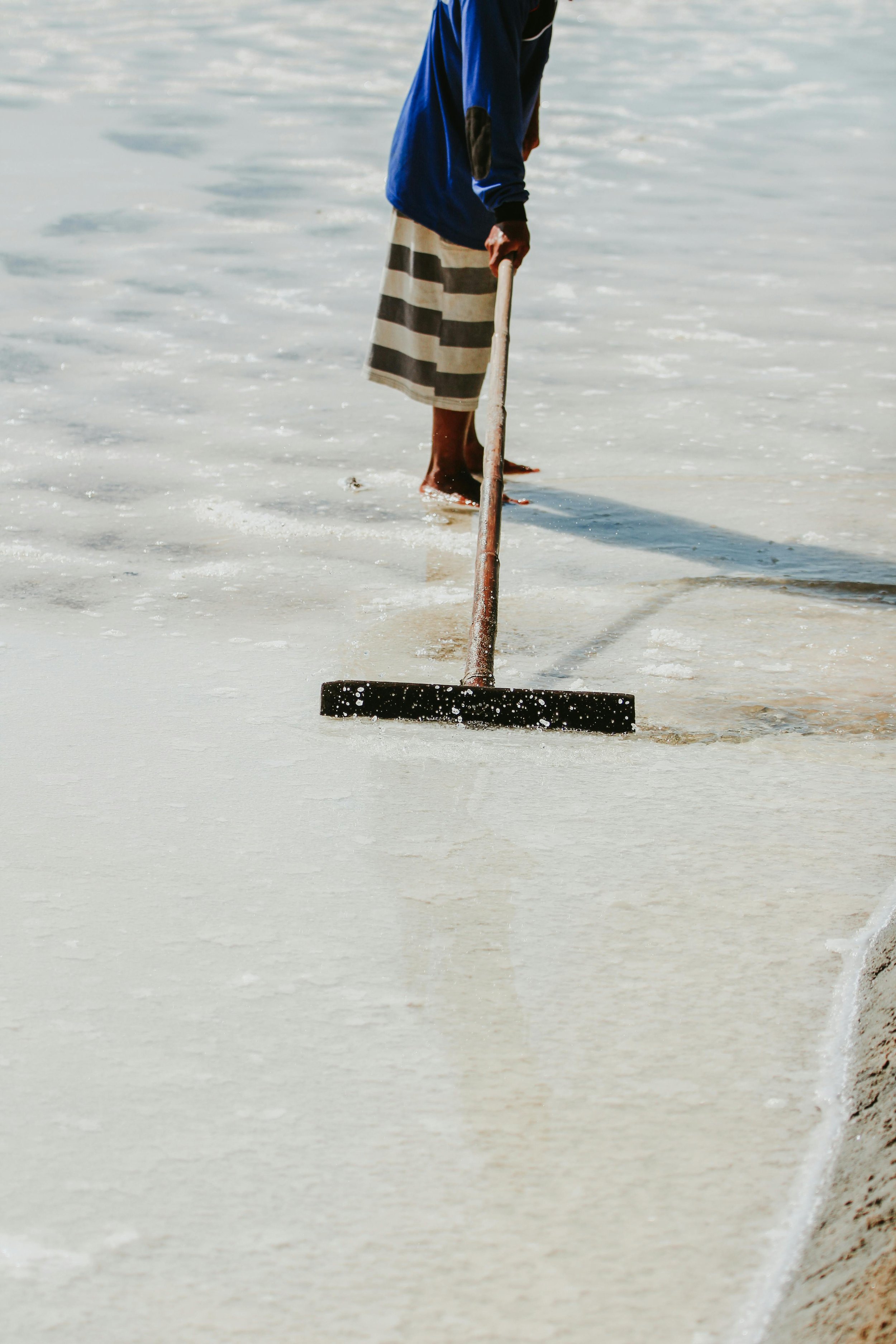
The salt flats stretched white and endless under the morning sun. Akosua had been working them since the sun first cracked the skies at dawn. It was a process she knew as intimately as the face of the man she had once held with her hands. She pulled the brine into pools with her rake, then let it dry so she could harvest the crystals. Her movements were in time with three years of repeating the same cycle, so often her body knew what to do without thinking.
The other women at the shore worked the salt flats to the north. She could see them sometimes, sweating under the heat of the sun and caught up in gossip. They had not worked near her since Berko was lost at sea three years ago.
Her mother-in-law had told her once, during those first terrible weeks, about how salt remembered everything. The tears of a drowning man, the wandering spirits of those lost at sea, the sweat of fishermen. Everything returned to the shore as white offerings. It is white, pure and useful. Akosua had accepted this and found space in the hollowness of her grief to find hope that her husband will return to her one day.
Akosua was scraping crystals into her basket when she heard the shouts. They were distant at first, but then they grew louder and each one more urgent.
“Nipa mbraa oh. Help! Someone,more hands!”
Akosua pulled herself up from her flats and followed the direction of the screams. Two boys were struggling in the surf, as they dragged something between them. The waves fought them, knocking them sideways over and over again. Each time they thought they had control, the tide surged and sent them stumbling, while the thing between them dragged where the water willed. A few times, both boys and the object were submerged under water.
“Hold him well!” one shouted as the tide pulled and knocked them off balance again. “Help.” Calling out to the onlookers on the shore.
They managed to hold on long enough to drag it past the shoreline before collapsing onto the sand. Behind them, the waves kept striking the shore, loud and unrelenting in its attempt to drag them into its depths.
By the time Akosua reached them, a crowd had gathered. They shifted their bodies away from her path. No one wanted their body to brush against hers. Mouths pinched upwards, eyes narrowed and one by one people she had once considered as neighbours edged away from her path, careful not to let even a shoulder graze hers
The man the boys had dragged from the sea lay face down in the sand. His body was slack as though he had already succumbed to the cold hands of death. His skin had taken on a dull grey colour under the sunlight, and his hair clung to his head in knots of kelp and sand. When the boys rolled him over, seawater spilt out of his mouth. The man did not move. Suddenly, he sucked in air so loudly that it sounded like someone was violently tearing a cloth apart, and then he went still once more.
The murmurs started immediately.
“…not possible.”
“… It can’t be.”
“…na spirit oh.”
“…he is breathing oh.”
She caught fragments but the words sounded like those brief interrupted voice of a radio presenter that were caught in between the turning of a radio knob and the white noise that followed when in between stations. Her attention was fully on the man on the ground. He wore the face that she knew so well, a face she could pick out in any crowd, blindfolded with only her hands as guide.
Auntie Esi knelt beside him first, brushing sand from his forehead. That act revealed the scar that cast away all Akosua’s doubts. It was the half-moon-shaped mark she had traced her fingers on many nights when she had teased him that the moon had marked him out of jealousy.
“Berko,” she whispered, but in the silent gathering, it sounded like a bell tolling.
The crowd recoiled. “Her dead husband!” someone shouted. “Back from the sea!” Another spat into the sand. “Abomination!”
Akosua went down on her knees next to his body. She cupped his hand to her cheek and shuddered from how cold it was.
Auntie Esi gripped her arm and tried to pull her away. “Akosua, that is not your husband. It is a sea spirit. Let go!”
“A cursed being,” someone echoed behind them.
“Leave him,” Auntie Esi pressed. She pulled Akosua, but Akosua was like rock, unmovable next to the body of her husband.
Akosua bent low till her lips almost touched his ear. “Berko.”
His mouth moved then, cracked and salt-dry, forming the word she thought she would never hear again from his lips.
“Akosua,” he opened his eyes, starred at her with a far off look, then he shut them and his body went limp.
Akosua looked away from him to the faces surrounding them. “Help me carry him, please”
No one stepped forward to help her. Some even shifted further from the gathering while the ones that remained only stepped aside, watching as she dragged him by herself. Step by step she pulled him across the sand and his heels marked a trail behind him as his body was moved along on the ground.
Salt wife. Salt wife. She has called her husband from the sea.
Inside the safety of her hut, Akosua laid Berko on the mat in the far corner. She eased him down slowly, afraid he might shatter. His skin was so cold that she flinched when she pressed her head to his chest. She found a cloth and rubbed him hard, then even harder still to dry the water on his skin but no matter how much effort she applied, water kept seeping from his skin. It gathered under his body like a squished puddle. Akosua wiped and wiped until her arms ached, until the cloth was soaked through, but the water did not stop. The sea had followed her husband home.
She cradled his head on her chest and tried to pour water past his lips. Berko swallowed weakly and a moment later sprayed droplets on her face.
“Easy,” she whispered, praying her racing heart did not break the façade of fear she was trying to hide. “You’re home now.”
He opened his eyes and locked onto her. “Akosua,” he said. “Is it really you? Are you real?”
She brushed the half-moon scar with her thumb. “It’s me. You came back.”
“It was dark down there. So dark. But I heard you calling.” His hand found hers and squeezed. “I followed your voice home.”
Akosua could not move. Had her grief sharpened her prayers into something the ocean answered? Had her prayers at dawn and dusk reached so deep into the water that they pulled him out. It had brought him back to her, but the hair on her skin had been standing since she first touched him on the beach.
He tightened his grip on her hand so hard that he almost crushed it.
“The sea,” he whispered. “Down below. They are waiting for me.”
“It’s okay,” Akosua kissed his face, tasting the seawater on it. “You are home. You came back.”
“They are calling,” he looked towards the door. “They are angry. Oh, they are angry. They are coming.”
His body shook violently and then slumped heavily against her. She pulled him close and began to rock him.
“My Berko,” she breathed into his hair. “You are mine. Whatever you’ve become, whatever the sea has done to you, you are still mine.”
The sea refused to be silent that night. The sound of the waves crashing against the shore was louder than usual. The air was colder than her recollection could pull. When she breathed, she could see it mist under her nose.
Akosua sat beside Berko and listened to the angry sea roar throughout the night. She kept her eyes on his chest, counting each time it rose and fell, afraid it might stop altogether or he would disappear if she looked away. The cloth she had been drying him with lay abandoned in the puddle beneath him.
The sound of chanting drawing towards her hut was the only thing that forced her away from him to the doorway. Her hut was surrounded by men and women from their village. Many of them were armed with fishing nets, machetes and pestles. Leading them was Nana Kwesi, the oldest fisherman, the man’s whose canoe, Berko had last worked on. Beside him was the fetish priest in a white loincloth. The fetish priest’s forehead was painted with chalk and he had a gourd rattling in his hand.
“Bring him out!”
“Cast him back into the sea!”
“He must go!”
Nana Kwesi raised his hand and the crowd silenced.
“Akosua. The sea is angry. That thing in your hut must return to it. Nothing good can come to Ningo if it remains here.”
“Return him!”
“Throw him back before he curses us all!”
Behind her, Berko moaned. To her, that sound was all the proof she needed that her husband was alive and with her.
“You will not take him!” Her voice trembled but carried over their threats. “He is my husband. The sea gave him back and you will not take him from me.”
The gathering turned to each other, surprised at her outburst. A few of them spat on the ground with an adequate sprinkling of “god forbid” while others crossed themselves in the wrong order. The priest shook his gourd too hard, then he paused, looked around and shook it again, slower this time as if correcting a mistake.
“The sea does not give back,” Nana Kwesi shouted. “If he breathes, he breathes with the lungs of spirits. If he speaks, he speaks with their tongue. Such a man cannot remain among the living. He must return to the sea.”
“Is it even a man?” someone demanded.
“Sea spirit!” they began to chant.
“Do you think I wanted this? Three years, I begged for a body to bury. Three years I listened to you call me names—salt wife, odo killer, man-eater. And now, when my prayer is answered, you want me to give him back?”
They responded with silence. Many avoided looking directly at her.
“Akosua, listen to the advice of those older than you. Do you want to doom us all?” Nana Akwesi asked.
“And what of me?” Akosua demanded. “Who will speak to me when my husband is taken again? Will you all step away from me, afraid that if you stand too close, your own husbands will disappear?”
Then Berko’s voice drifted from inside: “Akosua…”
The crowd recoiled as one body. The loud and sharp intake of breath rippled through them in unison. Someone cried out and some stumbled back, tripping over one another in their haste to put distance between themselves and the abomination in the hut. The priest’s gourd slipped from his hands and struck the ground. He reached for it in haste and began chanting louder than before.
Nana Kwesi’s face darkened. “You hear? He calls with the tongue of the drowned. If you love this village, Akosua, you will give him back to the sea.”
“No.” Her voice was clear. “I will not.”
The crowd erupted in anger. Someone hurled a stone that clattered against the hut’s wall, missing Akosua’s face by inches. Auntie Esi pushed forward.
“Child, listen. You cannot fight the sea. If you hold him, you hold your own death.”
Akosua met her gaze. “Then let death come. I have lived with his absence. I will not live with his loss again.”
The priest raised his gourd high and began to twirl, invoking the gods. The crowd’s voices blended with his chanting. Inside, Berko coughed. Akosua turned her back on them and rushed to his side.
She clutched his hand. “You are mine,” she said, voice cracking. “You are mine, Berko. Not theirs, not the sea’s. Mine.”
She lay her head on his chest. The rhythm of his heart still felt wrong in her ears. There were moments it beat steady, and sometimes it faltered like the waves when they lost momentum.
His lips moved. “They are calling for me. They want me back below the waters. They are waiting. Don’t let them take me again, please.” His face contorted, and a lone tear dropped from his left eye and rolled down to his ear.
Akosua tried to comfort him. She tried to hold his gaze and offered a smile. His eyes held her, but the gaze was not his own. It felt like she was looking into the depthless ocean. It dragged her down into its shadow.
When he finally closed his eyes, Akosua felt like she had just come up for air after being held under water for too long.
Outside, a stone cracked the clay wall. “Bring him out, Salt Wife! Or we will tear the hut down!”
Perhaps if they saw him, they would understand, she thought. She pulled him upright. He leaned heavily on her, and together, they staggered to the door.
The crowd fell silent. Berko could not stand. Water still dripped from his hair and skin. His grey skin shone in the light of the torches they held.
“Does he look dead to you? Look at him?” Akosua pleaded.
Berko suddenly hunched over and vomited seawater onto the ground.
“Spirit! Throw him back!”
“Maame wata sent him.”
The sea roared in response. Waves crashed louldly against the shore. Berko’s body heaved in rhythm with them.
Akosua planted herself in front of him. “You will not take him!” she cried to the villagers, to the sea, to any god that was listening.
Another wave crashed, so loud the ground trembled.
“Take him!” Nana Kwesi commanded. “Or the sea will drown us all!”
The men moved forward. Akosua screamed, spreading her arms in front of Berko. They shoved her aside. She fought back, digging her nails into skin. She jumped on the back of his hand and tried to pull him back. She was unmatched against their strength, and they moved past her like she was nothing. They threw a net over Berko and dragged him into the open.
She stumbled after them. “He is mine! He is mine!”
No one listened. The priest rattled his gourd in celebration as they dragged Berko down the path to the sea. The waves rose higher, roaring in welcome.
At the water’s edge, they swung him and cast him into the waves. The sea rose up and swallowed him, then it broke over the beach with a thunderous clap. There was silence as the waves eased and the wind stopped raging in anger. The sea had accepted its offering.
Akosua broke away from the crowd and threw herself into the water after Berko. The villagers followed her, trying to stop her. Some called out her name, reaching out with their hands to grab her cloth and skin, but the sea was quicker. The waves lifted up as if it were alive and pulled her out of their reach, dragging her from the shore.
At dawn, the tide rolled her back. She lay on the sand, her hair tangled with seaweed and her skin a mixture of sand and water. She rose slowly from the ground and walked back to the salt flats without looking at the curious faces watching from the shore.
The waves dragged her under, down into the cold and the darkness, salt burnt her eyeballs, her ears were full of the sound of water. The world above ended. All the cries, the bodies, the splashing, it disappeared, leaving only the pressure of the water that pressed against her from all sides. She did not fight it anymore.
That morning, the women who worked on the salt flats on the north side of the sea wondered why they had seen Akosua the day before, wrestling with an empty net in the surf, dragging it up the sand while screaming for help. They explained it as part of her odd ways, talking and arguing with herself, as she’d done for three years since her husband disappeared.
Back at her flats, Akosua bent over her rake, drawing the brine into shallow pools. She worked with measured care, diverting the water into precise channels, before stepping back to allow the sun to evaporate it.
When the crystals started to appear, they crackled like small flames under her bare feet. She however, felt no discomfort as she stepped over them. She kept moving to the steady beat of her own rhythm, and the water complied with her rhythm as it fell into patterns of salt.
To the north, the other women bent over their own flats. She could hear them talking and gesticulating at her. She was the salt wife of Ningo, and she no longer felt shame in the name.
Salt remembered everything. The tears of a drowning man, the wandering spirits of those lost at sea, the sweat of fishermen. Everything returned to the shore as white offerings. It is white, pure and useful.
Her mother-in-law had told her that once during her mourning period. To work with salt was to harvest grief each day. And her grief stretched white and endless before her. She bent and scooped a handful of crystals, letting them run through her fingers.
Her face was empty, but the salt remembered.
May 25, 2026
ABOUT THE AUTHOR
YEAYI KOBINA is a Ghanaian author, television producer and digital content creator who specialises in bringing narratives to life through immersive storytelling. He is the creator of A Weaving of the First Gods, a historical fantasy book series that reimagines the rise of the 16th-century West African Asante Kingdom, and a finalist of the 2024 Tampered Manuscript Prize awarded by Tampered Press to a Ghanaian author.
*Cover Image by Setengah Lima Sore on Pexels